On closer inspection, each bathtub seemed to have its own personality, and I couldn't resist sharing the faces I discovered in the bathtubs! Sometimes the camera can be a way to discover the unexpected and to give us an opportunity to have fun and laugh.
Tuesday, August 14, 2012
The Face in the Tub
On closer inspection, each bathtub seemed to have its own personality, and I couldn't resist sharing the faces I discovered in the bathtubs! Sometimes the camera can be a way to discover the unexpected and to give us an opportunity to have fun and laugh.
Saturday, July 14, 2012
The Secret Life of Trees
"I am affected by a visual experience - it is meaningful and beyond articulation. When I look at a tree, I cannot forget the invisibles - the ants, the water system inside the tree, the birds, the insects and other animals who depend on the tree for shelter and food. I try to make the invisibles felt. I have a deep empathy with nature, and when I am photographing her I feel a certain communion. I feel in love."
Ruth Bernhard
American Photographer ( 1905 – 2006)
Think about the secret life of a tree ("the invisibles") when you make a photograph of a tree and consider how your image can reflect this magical inner life that is present in most living things.
Thursday, July 12, 2012
Abstract Photography Exploration
Ordinary things take on different dimensions when we focus on the details or photograph from unusual angles to highlight shapes and lines, or color, pattern, and texture. The resulting images may not remind you (or the viewer) of anything you know, but it will engage your brain as you try to make sense of what you are seeing. Viewing abstract imagery engages our vision in a different way. I believe our creativity is expanded when we see things we have to think about, without knowing exactly what they are.
Take the opportunity to focus on things that draw you in, that make no sense as conventional photographs, but that speak to you through their shape, color, pattern, or some other abstract element. One has to employ careful observation to discover an effective abstract image in the multifaceted world we live in.
What abstract elements appeal to your senses?
Tuesday, July 10, 2012
This Summer take your Camera on an Artist Date
The Exploration on page 44 of The Creative Photographer suggests that you take your
camera on an Artist Date. I first learned of this idea from the book The Artist's Way by Julia Cameron. Julia suggests that one should always go on
an artist's date alone. I like to think of my camera as an extension of
myself and an artist's date as a kind of play date with myself and my
camera.The photographer version of the Artist Date is an outing where you go not to take "good" photographs, but to just experience being in an interesting place where you can observe everything around you and become more aware and sensitive to your surroundings. Yes, you might go home with many new images, and perhaps these new images will serve as inspiration for you in some way, but the main objective of the outing is to experience time with yourself and become present to the moment and everything around you. By giving yourself permission to take these outings you will expand your creative horizons and you will begin to think of yourself as an artist. In addition you will come to understand that time alone with no expectations of yourself to achieve anything profound, is an extremely important part of the creative process.
You can also expand this idea into something a little different by asking a group of friends to bring their cameras and come along with you. Pack a picnic lunch and head off on a road trip, stopping whenever you see something you would like to photograph. It is my experience that when you are seeing the world through the lens of your camera you are in a world of your own and very often forget you are with other people. You can also plan a trip to a specific location and draw up a list of things you will all photograph. Each of you can then take time on your own exploring this location with your camera, re-grouping after a couple of hours to share photographs over a cup of tea or coffee. If you photographed from a list you will notice how everyone experienced seeing things in such different ways.
Monday, May 28, 2012
Seeing with Quiet Eyes: Photography as Meditation Retreat
Last month I was fortunate enough to teach Photography as Meditation to a wonderful group of 31 photographers ranging in age from 17 to 73 at the Buddhist Retreat Center in Ixopo, South Africa.
One of the ideas that I shared was approaching the practice of photography with "beginner's mind". This Zen Buddhist concept encourages one to enter into the study of a subject with a lack of preconceptions and an attitude of openness and eagerness. Seeing with the eyes of your inner child or with an attitude of wonder can also take you into this space of being present to beauty.
The poet John O'Donohue in his book Eternal Echoes says this about wonder: "Wonder is a beautiful style of perception; when you wonder at something, your mind voyages deep into its possibility and nature. You linger among its presences. You do not take it for granted and are not deceived or blinded by its familiarity. The sense of wonder keeps experience fresh and original."
Would you see differently if you saw with the eyes of your inner child, seeing something for the very first time? Wouldn't the whole world seem full of wonder?
Surrounded by the natural beauty of the rural countryside of South Africa no-one had any trouble with this idea.
The teaching studio at the Buddhist Retreat Center
The library at the Buddhist Retreat Center -
a wonderful place to spend a quiet afternoon
A corner of the Zen Garden
Thursday, April 19, 2012
"The Creative Photographer" wins a 2012 Silver Nautilus Award
Nautilus Awards recognize Books that promote spiritual growth, conscious living and positive social change, while at the same time stimulating the "imagination" and offering the reader "new possibilities" for a better life and a better world. Jean Houston says: "These books are creating a curriculum for a world that longs for a new story." I am honored and grateful that my book has been presented this award.
Wednesday, February 15, 2012
Photo Linocuts
In the chapter on Photography as Meditation in The Creative Photographer, Exploration 8 (page 140) shows you how to make linocuts using leaves from your garden.
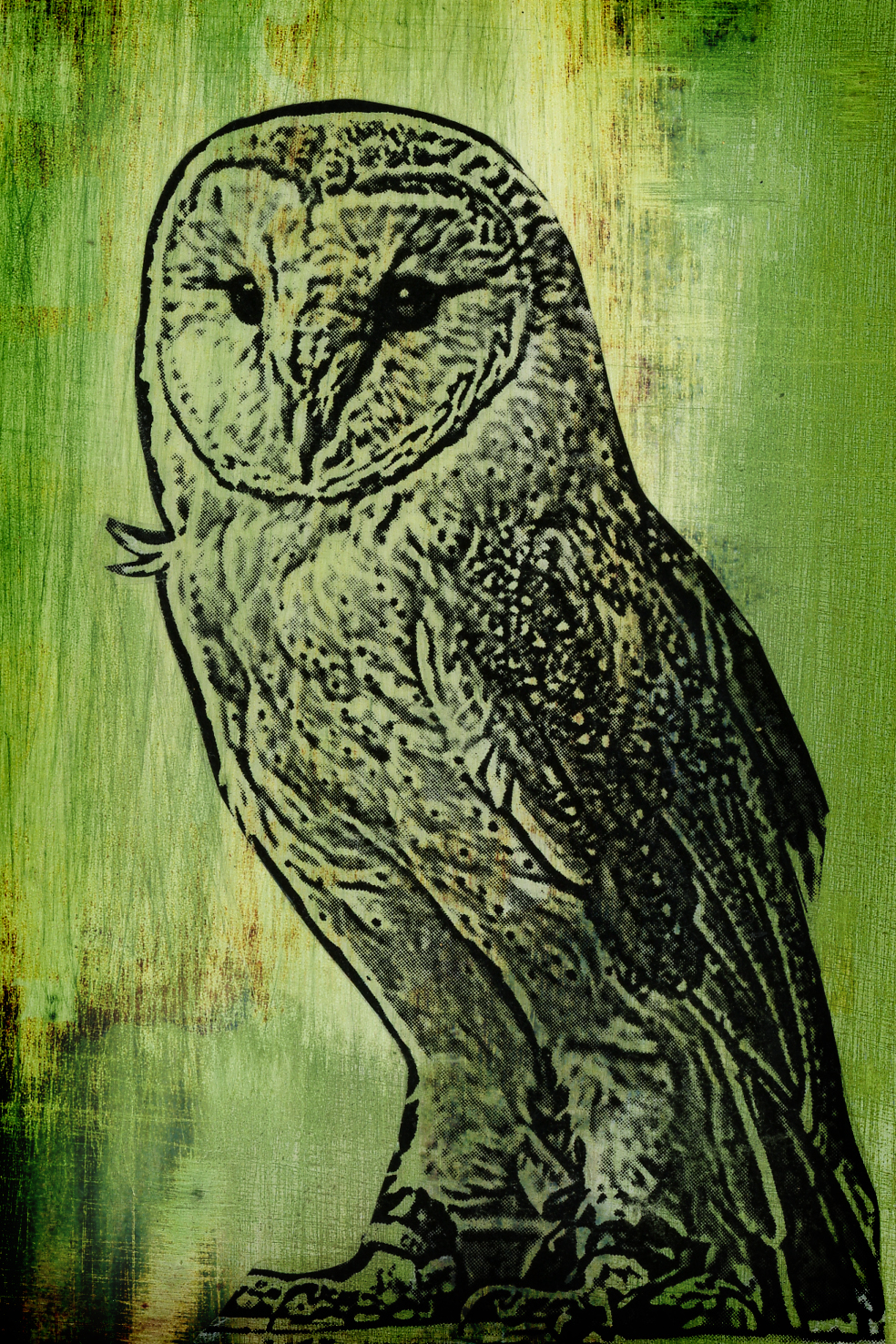
However, this method can be applied to any of your photographs as well. This is how I created this black and white linocut of a photo of this Barn Owl using Photoshop Elements:
1. Open your digital photo in Photoshop and make a duplicate layer.
2. Go to Enhance > Unsharp Mask. Set the Amount to 500% and the Threshold to 0. Try a Radius setting of 8 to start, but also adjust it to see if you like any of the other settings better.
3. Go to Filter > Blur > Gaussian Blur and set the Radius at about one quarter of the value of the Radius setting in Step 2. above.
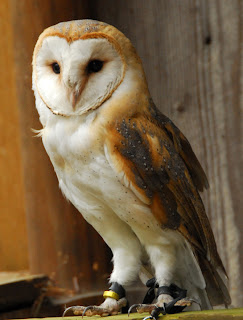
4. Repeat the Enhance > Unsharp Mask step in 2. above.
5. Finally, go to Filter > Adjustments > Threshold and adjust the Threshold level until you create an image that you like.
You now have your black and white linocut! I printed my linocut barn owl out on white paper with my laser printer, then used the packing tape transfer method on page 95 of The Creative Photographer to make a transparent image which I pasted on a green background after cutting around the owl.
This is a great way to use your photographs in art projects.
However, this method can be applied to any of your photographs as well. This is how I created this black and white linocut of a photo of this Barn Owl using Photoshop Elements:
1. Open your digital photo in Photoshop and make a duplicate layer.
2. Go to Enhance > Unsharp Mask. Set the Amount to 500% and the Threshold to 0. Try a Radius setting of 8 to start, but also adjust it to see if you like any of the other settings better.
3. Go to Filter > Blur > Gaussian Blur and set the Radius at about one quarter of the value of the Radius setting in Step 2. above.
4. Repeat the Enhance > Unsharp Mask step in 2. above.5. Finally, go to Filter > Adjustments > Threshold and adjust the Threshold level until you create an image that you like.
You now have your black and white linocut! I printed my linocut barn owl out on white paper with my laser printer, then used the packing tape transfer method on page 95 of The Creative Photographer to make a transparent image which I pasted on a green background after cutting around the owl.
This is a great way to use your photographs in art projects.
Subscribe to:
Posts (Atom)